
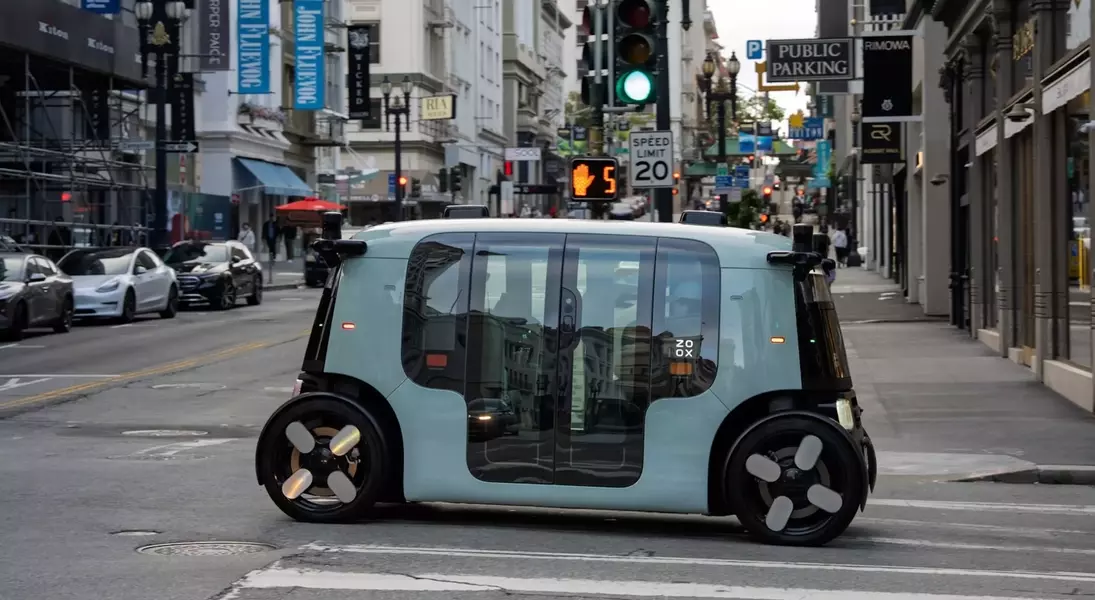
Zoox, the Amazon-owned autonomous vehicle company, has secured a significant regulatory approval, paving the way for its commercial robotaxi operations. The National Highway Traffic Safety Administration (NHTSA) has granted Zoox a temporary exemption that permits the deployment of up to 5,000 vehicles annually over the next two years. This exemption is crucial for Zoox as its vehicles are designed without conventional driver controls such as steering wheels, pedals, and mirrors, focusing entirely on passenger experience. This development places Zoox in direct competition with other major players in the autonomous driving sector, including Google's Waymo and Tesla's robotaxi service, both of which are actively expanding their presence across the United States. Zoox plans to launch its paid services in Las Vegas next month, with intentions to extend its operations to Miami and Austin thereafter.
The NHTSA's decision underscores a growing confidence in the safety and readiness of advanced autonomous vehicle technologies. The agency's assessment concluded that Zoox's robotaxis meet or exceed federal motor vehicle safety standards, despite their unconventional design. As part of this exemption, Zoox will operate under enhanced oversight, a condition that may evolve in line with advancements in its self-driving technology. This regulatory milestone follows a period of testing where Zoox provided complimentary rides in San Francisco and Las Vegas under a demonstration exemption, and it comes shortly after a software recall for its vehicles to address potential issues with smoke detection, demonstrating the ongoing refinement and scrutiny within the autonomous vehicle industry.
Regulatory Approval and Market Expansion for Zoox
Zoox has achieved a critical regulatory milestone, obtaining a temporary exemption from the National Highway Traffic Safety Administration (NHTSA). This approval authorizes the Amazon-owned company to deploy as many as 5,000 autonomous vehicles each year for the next two years. Notably, these robotaxis are uniquely designed without traditional driving components like steering wheels, foot pedals, and conventional mirrors, emphasizing a passenger-centric interior. The NHTSA's decision reflects a positive evaluation of Zoox's safety protocols, deeming its autonomous vehicles to offer a level of safety equivalent to or superior to that of vehicles adhering to standard federal safety requirements. This regulatory clearance is a significant step, transitioning Zoox from pilot programs to full-scale commercial deployment.
With this exemption, Zoox is now poised to enter the competitive market for ride-hailing services. The company is set to begin charging fares for its robotaxi services in Las Vegas starting next month, with plans to expand into other key urban centers such as Miami and Austin. This move positions Zoox directly against established and emerging autonomous vehicle operators like Waymo, a subsidiary of Google, and Tesla, led by Elon Musk, both of which are aggressively expanding their own driverless transportation offerings. The NHTSA's streamlined approval process for autonomous vehicles over recent months has facilitated such advancements, indicating a broader trend towards integrating self-driving technology into mainstream transportation. The regulatory body has also mandated enhanced oversight for Zoox, with provisions for updating these conditions as the company's autonomous driving technology progresses, ensuring continuous safety and performance monitoring.
Advancements in Autonomous Driving Technology and Safety Standards
The recent approval for Zoox to commercialize its robotaxi service highlights significant progress in autonomous driving technology and the evolving regulatory landscape designed to accommodate these innovations. The NHTSA's decision to grant an exemption to Zoox, allowing for vehicles without conventional controls, is a testament to the advanced safety capabilities demonstrated by these driverless systems. This exemption was based on a thorough assessment concluding that Zoox's robotaxis provide safety levels that are at least comparable to, if not better than, vehicles that comply with traditional federal safety standards. This reassessment of safety benchmarks is crucial for the widespread adoption of autonomous vehicles, as it acknowledges that innovative designs may necessitate different regulatory approaches while upholding paramount safety objectives.
Zoox's focus on a passenger-first design, featuring an interior with dual bench seats and sliding doors, reimagines the vehicle experience by removing the necessity for a human driver. This innovative approach requires a comprehensive safety framework that goes beyond the presence of human-operated controls. The "enhanced oversight condition" stipulated by the NHTSA ensures that as Zoox's self-driving technology continues to evolve, regulatory scrutiny will adapt accordingly. This adaptive oversight is vital for monitoring performance, addressing potential issues proactively, and building public trust in autonomous transportation. The company's prior experience offering free demonstration rides in San Francisco and Las Vegas, along with its proactive software recall for smoke detection concerns, further illustrate the rigorous testing and commitment to safety that characterize the development of this cutting-edge technology.